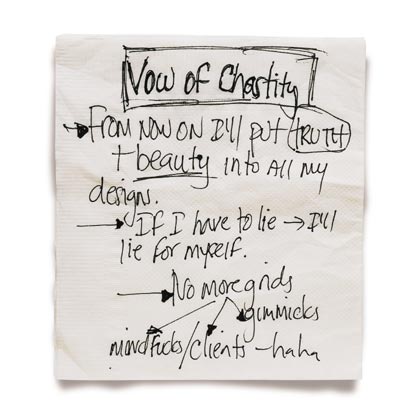
Design Anarchy is a theory, a point in history, a book and a politically driven reaction to consumer culture. Many designers (*cough* stern modernists *cough*) react to Design Anarchy as an affront to them personally, to design, what they've been taught or other ideals. The common thread seems to be "...avoid design anarchy at all costs.." (I read that today in a book)
Design Anarchy (the book) calls on graphic designers, illustrators and others to turn from working in service to corporate and political pollution of both the planet and "the mental environment", and to embrace a radical new aesthetic devoted to social and environmental responsibility.
Mashup Culture is really nothing new, collage and re-interpretation of the sign to create new sign is nothing new. What is relatively new is the abundance of mass mediated images, flickering, permeating and penetrating our minds before we go to sleep at night. There is a lack of critical awareness and myth decoding being taught in our school system (surprise surprise) I am constantly amazed on a daily basis just how spongy we are - or how one thinks the news is real - or why we reveal our personal information to get a free whatever. Simulacra is what is real, our realities are hyper and there are a new set of rules in play. We are living in an age of complexity.
Design seems to be at a crucial point where ethics should be considered above everything.
Again I go back to my concept of 3rd space - where design and art combine. It may be called 'design activism' or 'design anarchy' 'design of dissent' or even more broadly 'design for social change' but we must realise that these spaces can only exist with malleable or (is it even possible) no filters. (I'm talking about Chomskys 'filters' in terms of propaganda model here) ((The theory posits that the way in which news is structured (through advertising, media ownership, government sourcing and others) creates an inherent conflict of interest which acts as propaganda for undemocratic forces.))
We cannot be ignorant to the truth that 99% of design exists within the propaganda model. Just sayin'. So fighting against this wave takes courage, passion and dedication. Most of all it takes empathy, and that requires love.
Creativity
Creativity.
What. Is. It ?
What I've read so far on 'Creativity' is a bit like what I've read on 'Design Thinking' academics trying to define a buzz word and concrete 'the sign' (in this case the term) to an ambiguous (lets face it there's no 'common' elements that are convincing) set of .. values. The argument almost becomes a battle of linguistics. The chain of argument which is largely empirical or behaviorist is weak - and quite meaningless. Maybe the academics are hoping that if enough of them agree on what 'Creativity' means - then that'll become the common agreement ..the truth .. after all that's how semiosis works. (and research ((don't shoot me))
I also think there are philosophical issues which come to mind like 'Is Creativity a Universal? and if so, then, does it even exist?' This path leads nicely to the fact that if creativity cannot be explained then it may be easier to start with - what Creativity 'is not' (deductive reasoning)
Then others state the obvious. Process. From divergent (play, open) to convergent (decision, closed) thinking. (Although I see this more of a popping in and out of both, feedback looping type scenario)
Nothing I've read so far has come even close to striking a chord with me until I came across this video of John Cleese talking about creativity. (It also has a FAB ending)
So good. Sooooo much better than the million of LAME TED talks by 'top design professionals'
I follow Improvisation Blog Which is penned by fellow kiwi Mark Johnson. How I came across the site is a bit odd, I basically saw him blogging at Ascelitite 2012 and decided to look it up. The guy is a machine and he pretty much spouts intense and intriguing thoughts around all things Ed Tech and HE related.
Anyway, he had posted the video on his post on Creativity (which is a breath of fresh air). As a designer and artist I can relate to 'defining absences' (which agrees with me more than 'making new connections')(Tho Cleese explore this admirably).
This is why I simply adore 'the space in between' I am in love with it, it's what all artists seek, and it's what all viewers search for. There's an is-ness and at-ness about the experience, epiphenomenal qualia. To me, this is the creative space.
My whole life I've been called a 'creative' and 'unique' person.. to the point where I wasn't sure if it was a complement or not. And when your livelihood depends on being creative and clients expect you to come up with amazing creative solutions each time - well that can threaten what creativity is - a fun, playful and experimental endeavor! It feels strange to try to define something which is so personal. It's like defining 'love'.
I'll protect my creative ways and nurture them, avoid exhausting them. Go to cafe's - visit galerrys, walk in nature and continue to feel inspired.
Thoughts on Instructional Design
You know something's changed when you find this page funny.
Today I finally found some half decent websites (not including the one above) for 'designers' who work on instructional projects. The resources for this field are growing with designers frustrated at the gap they find themselves in between education (higher ed. to be specific) and design.
Usable learning is quite good as a start point after you've read this to get a rather genreal overview of how it's all connected. Emergent radio is a station you can stream to provoke thoughts (if not a little frustrating and annoying) and Upsideleanring is a nice place to refresh and get some inspiration.
It took me quite a while to understand that the field of Instructional Design is not a typical filed of 'design' per se. And after attending Ascilite in Wellington this year I kind of, well, felt annoyed that people who had not been trained as 'designers' in the traditional sense, were calling themselves designers and using the term 'design' willy nilly. (I have 15 pages of frustrated notes but shows the need for my position!)
At the end of the day both graphic designers and instructional designers use design thinking, with the latter focusing on specific learner models and the former focusing on design principals. There needs to be more obvious and open communication between these two areas instead of designers creating with a lack of pedagogy and instructional experts advising with a lack of design theory. I'd also like if both parties didn't claim to be experts about the other if in fact they are not.
I am defiantly no expert in pedagogy learning outcomes and instructional design but luckily I work in a collaborative team with people who are. I am however trying to increase my knowledge in this area because I cannot design without doing so. I have learnt so much in the past 5 months of working within the University - but there is a long way to go, and I'm privileged to be gaining knowledge with every job I'm involved with.
Oh and I shan't forget to mention Hybrid Pedagogy it's one of the best sites I've found thus far (they have a FB page too)
Art vs. Design ... (See I put a 'vs' in there largely implying some sort of disharmony)
I often get asked "Gala, what's the difference between art and design?" It's one of those questions where I'm suddenly in a minefield, a maze - I see all the connections, I take a second, I zoom in - I contextualise - find myself and then define a box, a frame, an answer.
The box is never the full picture, and I find it extremely frustrating having to define a system or process. The problem with generalisations is exactly that - I'd much rather have a discussion - and visualise from all possible angles and perspectives. It seems to me that nobody seems to have the 'time' anymore. It seems to me like the value of time is continually shifting - becoming shorter whilst our lives are speeding up (Im with Paul Virillio on this one in terms of what this is doing to our communities). Being a holistic thinker and having to explain things in a cartesian ontology means supporting a value system where some ideas hold value over others. Academia is strongly rooted in this linear and hierarchal system, strongly supported by the scientific notion of 'weighted evidence'. But what of life's cyclic nature?
So when I get asked the question I kind of feel like my brain has a wee seizure (haha!) and my initial reaction is to make some horrible noise to communicate it all like "blaaarghshfkhsfkhs" these are the things that have occurred to me lately, and I think it will be useful for me to write down.
Lately I have been very attracted by the work of Barbara Kruger because she bridges art and design, I'm attracted to open source, and the idea of tool making and even design anarchy - hell why not make the most of both po mo and mo!
...but largely I feel guilty when I design because:
I guess at the end of the day as long as I'm aware of these factors, and question the true worth of my work then I'm doing OK - luckily enough I'm in educational media - a field where communication is taken critically and at a user level!
So, next time someone asks "What's the difference between art and design?" I can say, "Well if you were wanting a black and white answer, I'd say design is more rooted and beholden to modernism whereas art is in a post modern era and thus largely less restricted by social norms"
I give myself a hug, it's ok to acknowledge that the question strikes a chord with me and my self conceptualisation as both an artist and a designer.
Its OK to wear two hats.
phew.
The box is never the full picture, and I find it extremely frustrating having to define a system or process. The problem with generalisations is exactly that - I'd much rather have a discussion - and visualise from all possible angles and perspectives. It seems to me that nobody seems to have the 'time' anymore. It seems to me like the value of time is continually shifting - becoming shorter whilst our lives are speeding up (Im with Paul Virillio on this one in terms of what this is doing to our communities). Being a holistic thinker and having to explain things in a cartesian ontology means supporting a value system where some ideas hold value over others. Academia is strongly rooted in this linear and hierarchal system, strongly supported by the scientific notion of 'weighted evidence'. But what of life's cyclic nature?
So when I get asked the question I kind of feel like my brain has a wee seizure (haha!) and my initial reaction is to make some horrible noise to communicate it all like "blaaarghshfkhsfkhs" these are the things that have occurred to me lately, and I think it will be useful for me to write down.
- I see design as highly influenced and framed within modernism.
- I see art as post-modern (either re-constructive or de-constructive).
- I see myself either falling into one or the other depending on circumstance.
- I struggle with both - because of the influence of the other (po-mo vs. mo)
- I am in love with where and when they meet, reference each other or reference themselves.
Lately I have been very attracted by the work of Barbara Kruger because she bridges art and design, I'm attracted to open source, and the idea of tool making and even design anarchy - hell why not make the most of both po mo and mo!
...but largely I feel guilty when I design because:
- It is hard avoiding the pitfalls of modernism when all the rules (hard truths) around design are based on it.
- It is hard working with myths as that's the framework design uses to aim at users.
- It is hard treating 'the sign' with 'value' when the post modern part of myself believes that we are now largely living in a world of 'empty signs' (due to the myths) (and I am reinforcing this)
- It is not my place here to be ironic, it is my place to deliver a message.
- Within design there is am emphasis on convergent thinking over divergent thinking, (hey one's before the other in the process right!) to me this impedes on creativity.
- Due to the above point 'process' is often devalued compared to 'end product'
- Design often uses 'art' to disguise itself and make myth luring (aesthetics over function)
I guess at the end of the day as long as I'm aware of these factors, and question the true worth of my work then I'm doing OK - luckily enough I'm in educational media - a field where communication is taken critically and at a user level!
So, next time someone asks "What's the difference between art and design?" I can say, "Well if you were wanting a black and white answer, I'd say design is more rooted and beholden to modernism whereas art is in a post modern era and thus largely less restricted by social norms"
I give myself a hug, it's ok to acknowledge that the question strikes a chord with me and my self conceptualisation as both an artist and a designer.
Its OK to wear two hats.
phew.
![]() |
| Barbara Kruger |
Vitruvius
Vitruvius C1BC:
1. Firmitas: The strength and durability of the design
2. Utilitas: A designs usefulness and suitability for the needs of its intended users
3. Venustas: The beauty of the design
Problems that matter
I've been thinking, reading, sketching and ideating. Implementing social change through non-hierarchal webs, creating tools, fostering the community. Realising my part in it all - as a node, able to see the wider picture, realising context, staying critical but maintaining a belief in creativity - in change and in improved systems. Focusing on play, experiential learning, simplicity whilst maintianing respect for the past - what it has taught us, semiotics, social construct and cultural differences. Sustainability, connectivism, synergies and scaffolds.
Putting these thoughts into practice, into process. My moral responsibility as a designer, and how it's ok to make mistakes learn from the past and look constantly towards the future.
Quote
In his great book The Laws of Simplicity, designer and educator John Maeda writes, “The simplest way to achieve simplicity is through thoughtful reduction.” With a million different bits and bytes coming at us every day, simplicity isn’t just a design imperative any longer, it’s a productivity imperative - if not a sanity imperative.
Subscribe to:
Posts (Atom)