Why do people say "Oh that's just semantics" as if semantics are a negative thing?
Semantics, the study of meaning - or concern of meaning is surely, one of the most valuable assets to academia?
I notice that people use "It's a matter of semantics" as a way to close down a conversation, implying that meaning is constituted purely on a subjective level, up for interpretation - so there's little point in a wider dialogue - as we can't agree upon 'one single truth'. Of course this has SO many problems, yet people say it instinctually.
This infuriates me - should semantics not be a doorway to open up possibility and conversation? Do people generally misunderstand semantics? Why does semantics have such negativity attached to it?
What does it mean when someone says someone is "Just being semantic"?
Language.
Semantic = relating to meaning in language and logic.
My pre-disposition towards semantics in a general sense, I think is "Playing with words" As if some academics use language as a cloak of intelligence, as a gateway to keep out 'lesser' peoples understanding their meaning (aka academic wankery)
Yet in philosophy especially, words are everything, especially say if you are philosophizing about language itself. One is speaking in a history, a dialogue that get's higher and higher, building on itself, this is semantic in nature.
People use semantics as a criticism because they do not understand - they have been left out - the author didn't give two hoots about inclusiveness, many can't do Kant.
This is why I love visual literacy. There is more than one way to tell a story.
We can get through the problem with semantics by employing more than one type of language. Semiotics exists beyond linguistics - semiosis is largely achieved through visualization, a large part of our brain is for processing visual data.
Design has the power to break down and expand our notion of semantics.
The work of Nick Sousanis is a divine example of such.
Viva la semantics.
growth = time
I avidly believe in the interrelationships between ideas, design and the environment.
A large proportion of my reading centers around consilience, as a designer one has to be a jack of all trades, always knowing that the more you know the better, but having to decide where to stop (sigh) this is why most of us drink way too much coffee and think aloud.
Anywho, my recent foray into Design + Nature lead me to skim through The Nature of Design: Ecology, culture and Human Intention by David W. Orr. (2002), one of the more recent books to date and less engineering based than say Design & Nature V (2010). In the book Orr explains what he terms as 'slow' (shared, open and co-created, broader, cultural, sustainable) and 'fast' knowledge (high modernity, short time benefits). (*Ahem* think NZ Asset Sales)
Orr goes on to suggest that we should use natural paradigms in our design, in what he terms (unoriginally) as ecological design. Ecological design joins science, arts, ethics, politics and economics...He does not say how this would work alongside Capitalism...
Orr though seems to agree with me that 'fast' knowledge is bequeathed to us by Descrate, Galileo, Bacon and Newton - who encourage us to "separate subject from object, humankind from nature, and fact from value" (206)
Orrs ideology extends to a vision of a 'gentler world' which can be achieved through democracy and education. Orr "believes that higher Education restricts the way we design because of it's focus on unitary and necessarily disjointed objectives, while allowing the long perspectives and awareness of broadened effects to go begging." (91, Design issues, Vol22 (2), 06) He calls for the need to connect fields of knowledge. #futureEd
Here's where my brain did the snappy thing - this is exactly what the online distribution of knowledge can allow us to do. The shift to personalized learning environments (PLE) is an example of centralised to distributed networks - aka a shift in the design pattern.
Again it seems to me that we are closing Descartes divide and getting closer and closer to 'nature' and that this is freaking all the people in control out. Technology is shifting from a mimicking state into a state of self actualisation, and the reflexivity between media is so fluid that it's almost pointless to draw lines. Instead we need to focus on the construction of environments from a learner centered personalized pathway jive. This is how we maintain the humanizing factor in the construction of post human societies - by simply valuing the fact that there is a human at the centre of it all. there is humanness.
It's and/both. not either/or. Orr's work gets very polemic, like so many others. He rejects postmoderism as deconstructive negating to mention that the notion of absolute truth in modernism was even more damaging.
Gregory Bateson in Steps to an Ecology of Mind suggests that it would be foolish to sacrifice such ecological ideas on the alter of pragmatism" (481) So I'm going to keep thinking this way, also I feel, personally that this is ingrained in me - culture and social construction smacks you in the face everyday when one identifies as a queer*
Orrs concept of 'slow' and 'fast' knowledge reminds me, yet again, of Paul Virilio and dromology (a postmodern term for time/space compression) there's no doubt that technology has changed our time/space. If a tree falls in a forest and no one's there to hear it, does it make a sound? ... it depends, is there a webcam?
Speed and time are two VERY important factors in education. I often think they are the chisel and axe, sculpting what are our institutions and policies.
Online environments can be constricting or expansive - or both, pulsating like a heart. An important design question is - are we aiming for a fast or slow environment? Is this environment sustainable? should it be?
No conclusion today, just a bunch of thoughts.
Gala.
Visual Analytics
Galas initial thoughts on Visual Analytics.
- Visual analytics and leaning analytics can guise itself for presenting itself as learner/user centered but in reality the real goal may be to collect data and findings for individual researchers, or the wider institution.
- There is space for the research of Critical Realism (and the philosophy of perception) within this field (gap?)
- In terms of values, how is the individual treated? Permission must be sought – in this information age we must still consider privacy and the rights of the individual.
- Who is the data really for and what is it being used for? Need for transparency.
- The software development for visual analytics is determined on the data and purpose. This appears largely to be a case-by-case basis due to a variety of possible data sources – a universal set of principals can be established (as they have been) but contextually relevant design require expertise development. (time and money, special area of expertise)
- How much visual analysis in actually in action? – Funding and allocation towards this specialty?
- What can we learn if anything from the visual analysis of learning analytics from MOOCs?
- The so-called need for visual analytics comes from the so-called influence and abundance of the impact of educational technology in the classroom and online environments, and the so-called ‘displacement of the teacher’ within this. Critically speaking, these are all highly debatable claims and areas within higher education which have various truths and un-truths depending. (The arguments are exactly that and not necessarily reality) Thus the myths and determinism around ‘data’ and technology within education and empiricism are driving the VA Agenda. Thus it is important to note certain assumptions authors have and the field generally holds. So that we can determine the hype and the ideology from actual impact etc.
- There is a leaning towards empirical findings from data. This is common but suggests that there is space for qualitative approaches to VA such as interviews with teachers etc.
- Is this all a reaction to the mechanization of education Do teachers now not have enough time to talk to students one on one or are they just trying to justify having a computer do it for them..etc? is dealing with data in this way closing the loop or just getting further from the truth/at-ness?
- Should teachers play the role of ‘visual analytic tool’ are their own observation and their own brain and intuition and common sense and gut feelings and experiences being disregarded within all this or merely supported?
- VA is not ‘new’ simulations modeling has been happening for a while – a timeline of technologies and systems could help here.
- Where does the judgment lie? WHEN are decisions made?
- Ontology – who has the eyes – man or machine?
- Any software with user interaction often require training or expertise, you can’t just say you don’t want that.
- How does time and speed come into this? Is the VA movement just another tool to try to quicken efficiency? Is VA then de-humanising?
- Modernist design and utopian universalism is inherently problematic – what of personalisation, culture, accessibility ete. All users are different. – the decision of ‘organisng principals’ will be determined on the context, data and task at hand.
- In terms of the above – modular/parts thinking design such as the ethos of ‘prefuse’ may offer a solution. Open source and customisable and re-usable. Seems to be a sustainable flexible and collaborative way forward.
- Chaos theory, AI and fractal logic could play a role in prediction.
- We can borrow knowledge from systems thinking and modeling (such as boundary making and the purpose and context triangle)
- Can we create a domain specific infoVis application for Higher Education?
- Even if toolkits or software becomes usable and effective – does it make it ‘worth while’?
- In terms of the design ethic ‘form follows function’ we need to arise and adhere to this. We must be careful not to fit data into pre-established methods when we have a chance to radically alter the way we organise and perceive data in the first place. The medium is the message (McCluchan) and John Maeda (self referencing technology and copy cat transmissions). (his rules of simplicity) Does big data now have a new function in terms of information network etc? more discovery approach than representational – a creative space? A constructive space? A playful space?
- Theory holds high importance for VA, we must remain critical and well thought out – don’t want idealism etc.
- In terms of language and visual language – what is going on here exactly? How much is mental modeling What can we learn from nature – morphology and our own natural ways of decoding information (pre-established and ‘new’) adding an extra dimension doesn’t automatically make it new etc.
- Pre-established knowledge in how to read graph types is necessary – this isn’t necessarily as ‘intuitive’ as claimed.
- Where are we aiming the usability and and what skill level and skill sets? Who is the audience? We can’t just assume ‘one universal audience’ it could go anywhere from a computer illiterate to a highly specialised programmer.
- Designers have been successfully doing InfoViz for years – creating and playing in their own software.
- My own custom area of speicalisation could be in ‘rendering’ .. custom action types etc – this could get pretty creative!
- Need more testing for the end user being a lamen – getting them ‘thinking aloud’ ie. teachers.
- Issue of raw data coding and manipulation – authors neglect the human component in this – this is where a lot of the analysis even begins!
- ‘Information Aesthtics’ seems my particular space, another claiming a 'new' term.
- the shift is a democratization of visualisation. This shift co-incides with a shift in design and technology towards distributed networks.
- What is the “raison d’etre” (reason for being or existence) for data in the context?
- The number of approaches towards data visualisation highlights the importance of design and creativity in the visualisation field
- If it’s about engaging ‘lay’ people in understanding complex data insights – shall we not just get them to play with lego?
- Little research is on the design process of visualisations.
- The semiotic taxonomy is a step in the right direction – along with pre established methods – well thought out theory and an open interdisciplinary approach we need to also build a library of key terminology and skill sets.
- Nvivo and such data analysis software deals with this sort data (dynamic and diverse) for example and we could learn from them.
- VA can’t ‘make meaning’ for us – just visualise data. There still needs to be someone doing the work of coding all the bloody complex data! Is this not the biggest issue? Are we not sidestepping this issue?
- Dromology and time space compressions of post modernity seem relevant here.
- Considering the VA Agenda – how much of the ideology associated with terrorism etc. enters VA – why – how and to what affect? The classic military and tech link. Also, an emergency response involves time and pressure – so ‘illuminating the path’ reading in particular which a lot of the lit seems to refer to may not be that relevant for other areas.
- The big question seems to be can we apply human judgement to complex data in pressure filled situations? I’m not convinced that our brain can conceive – VA may be a bridge to understanding but not necessarily a solution to understanding big data. We may need trained specialists (think Minority Report)
- Why is new tech and new talent suddenly “urgent” now???
- What type of thinking does it take to be an analyst? Who is an analyst? Is this a specialisation and skill set?
- What do these so called ‘next generation’ of technologies look like? What makes them ‘new’? do we need an overhaul? A whole new paradigm?
- When is data ‘big’?
- Is this more of an AI issue or wanting to build a big growing adaptable mainframe?
- VA often used for ‘reducing risk’ this is interesting and opens up lots of ethical concerns
- Arguments against the science of analytical reasoning?
- Are the VA agenda principals even applicable for HE considering the principals should determine the design
- Key: “To provide task-appropriate interactions that let users have a true discourse with their information” Here there needs to be a greater emphasis on reflection and play.
- Interaction designers will have a lot of answers to these questions, the design field needs to work collaboratively with academics in other fields and vice-versa. We can learn a lot from interaction design – i.e. interactive exhibits. (And mapping interaction approaches to analytical tasks)
- Does everyone have the same level of visual literacy and understanding of visuals? I think not – this has failed to of been mentioned. Some are more apt at visual thinking and encoding/decoding visual information than others. – This also depends on the level of complexity – but the more abstract you risk either getting further away from the truth or closer to its purest form.. this argument of abstraction is a classic one and people argue either way. It’s often a threshold or point of reference We need to maintain a maximal to minimal bottom up approach When dealing with individuals we deal with subjectivist culture etc. there are qualitative differences to consider in this debate not just quantitative Semiotics hold a universal solution here > visual metaphor etc > but modernist deisgn has its pitfalls. We need a post modern approach.
- History needs to be referenced more – how is this new? We have ben visually analysing stuff for eternity. Let us not forget.
- Applying physical concepts like mass and gravity help people understand data and its true ‘weight’ (applying physics) as do common notions of space and time and narratives.
- Data types are continually changing – should we just assign everything with binary 0’s 1’s ?
- Whats this fascination with ‘reducing time’ good things take time! Speed and society – Virilio etc.
- Google analytics seems like a fine start point.
- Interoperability needs to be forward thinking – this is super difficult, as is Component-based software development. The computer is becoming organic and self organising..
Failure - Love it.
Lately I've been thinking about the concept of 'failure'.
After one of my visits to the sci library today I got out a book called 'Success through failure - the paradox of design' it's full of examples of designs that have failed, from bridges to skyscrapers (it's predominately an engineering book) obviously it concludes that innovative design is about anticipating and averting failure. The author rightly claims that we build success on the back of failure - not through easy imitation of success.
To me, this notion of failure needs to be emphasised in our critical thinking. Failure automatically appears as 'negative' but paradoxically, in time, it plays a 'positive' role. (learning from failure)
Different thinkers have tackled this in different ways. 'The queer art of failure' is a GREAT book by Jack Halbertsam. Halbertsam takes the notion of failure and puts it on a pedestal, adopting a sociological focus she attaches concepts of pride and agency in the difference that 'failure' espouses. There are similarities here with radical feminists and the growing voice in disability studies.
So what would this philoposhy look like in design? I know what it looks like aesthetically (think D. Carson etc) but what of in the teaching of design or what people think of design?
As I designer, I battle with the concept of failure. For it is what you are trying to avoid by having a tight well thought out, expansive and knowledge based process. But at the end of the day I am a 'human' designer, and humans are flawed. I notice that my fear of failure is emphasised by my 'being' as a designer, If a design fails - I fail. That's quite a load, and something they don't seem to teach you to deal with at design school.
But if this concept of failure was studied, and understood, it would no longer be feared. If designers could reflect a bit more and show more of their process - messyness, dead ends and kaputs, if the embarrassment around this was questioned - then I reckon it would surely help designers like me and the design community in general.
This week...
Things I'm loving this week:
This reading: http://www.academia.edu/4203522/Intersubjective-Systems_Theory_A_Phenomenological-Contextualist_Psychoanalytic_Perspective
New Bookshop in Dunedin
and
This reading.
Nice.
This reading: http://www.academia.edu/4203522/Intersubjective-Systems_Theory_A_Phenomenological-Contextualist_Psychoanalytic_Perspective
New Bookshop in Dunedin
and
This reading.
Nice.
Journalin'
I haven't posted an update in a while so here's some ramblings.
I've been aiming at narrowing down my thoughts into a tangible framework that I can base my teaching and research on. For a long time, this has always been the Ecological Philosophy - but I've been finding this too broad so have started pin pointing the theory into the areas I'm working in which is Design, Educational Technology and Higher Education.
There are plenty of examples of connectivist philosophers, researchers and academics. Bateson, Gablick and Thompson come to mind all offering similar views which oppose Cartesian Dualism providing alternative and often enactive forms of learning.
I'm finally starting to see the field I'd like to work within. There appears to be a group of thinkers who are the blossoming bi-forcations, upper echelons - envisioning the step beyond the likes of Ponty, Husserl, Vygotsky, Bandura..
By taking a critical theorist approach to educational technology whilst maintaing the mutual respect of the wider context (which Ecological models can offer me) and visualising this through my design skills I am pretty confident I can offer some amazing insights which will contribute to the research field.
Design wise, I've decided that this wave also correlates with what I am naming 'Design Ecology' or the second wave of Design Thinking. This wave is largely driven by community, sustainability, and social change.
I am in a unique position in my role at the University and am working on some pretty exciting projects at the moment which correlate nicely with my epistemology. Largely they are about representing community Engaged Learning and Teaching (AKA 'Outreach'). Not only do they personally allow me to think/visualise in an info graphics/systems way but also provide me with the possibility to co-create with the clients and actually engage in the wider community.
I've got some co-authoring papers in the pipe-line, have my sights set on journals I'd like to publish in and am creating a document for 'design issues in higher education'. I also have a back burning proposal with a question around the likes of "Are infographics a beneficial way of highlighting sustainability to students? ... Will exposing students to infographics empower their sense of agency within a wider system?" which is slowly fleshing itself out.
SO thats me for now. Letting that stuff consciously rise and fall, spin into a ball ready for me to pick up throw at a wall and go SPLAT into a cacophony of amazing qualia and colours!
![]() |
| Image by Jamie Lee |
HCI
Human Computer Interaction is something we can no longer ignore or disregard as science fiction. It's happening now. From the 'gorllia arm' (i.e. from google glasses) to the 'mobile chin', the gap is closing between digital technologies and our bodies. Issues around embodiment which have previously nested in the metaphysical space of philosophy are coming to life in-the-world as technology becomes increasingly complex, transparent and intelligent.
We have cameras that can take 3d images without a lens, and printers that print human tissue, not to mention robot surgeons! We have computers which can read human gestures, there is a new vocabulary being realised between man and machine and I am interested in how this is being designed.
But where's the innovation at? again, for uptake and adoption these guys are playing it safe. It's the same forumla - mimic, mimic, mimic - you can read the pattern - it's how money is made, new technology it seems is not too far removed from the Hollywood blockbuster.
Design is as much about power and control than freedom, 'freedom' and 'choice' are the words used to re-enforce a neo-liberal movement. You have a 'choice' to buy an IPOD TOUCH, you can touch what we let you touch in the way we have pre-determined for you to touch it. (infact we will even patent that type of touch)
"because there is so much benefit in the physical world, we should take great care before unreflectively replacing it"
There is a phenomenology in design that only gets realised through UCD and testing. Is this phenomenology/qualia changing as our bodies and the virtual grow closer? what effect does this have? and how much agency are we allowing the user? Over time, what effects will arise mentally and physically, and how will this shape our world? What have we really changed or learnt from? How much of this is socially constructed and how much is constructed for the social? Risk is having to choose an action which cannot be undone while the consequences of the action are not fully knowable ahead of time, yet with the challenges of risk come opportunities for more trusting, committed, responsible and focused interactions.
"when compared to other human operated machinery (such as the automobile), todays computer systems make extremely poor use of the potential of the humans sensroy and motor systems. The controls on the average usre's shower are probably better human-engineered than those of the computer on which far more time is spent" - Bill Buxton
I agree with the above quote. HCI my friends, is behind the times (*ahem or purposefully held back*), this is what makes it exciting from a design point of view - it's still shaping up. Google glasses may be a clonky step forward of extension of self, but it is a step forward.
Thinking through doing and theories of embodied cognition need to be a driving factor in the interaction design of these 'new' technologies. Can we allow and enhance elemnts of discovery and play, will we let the user manipulate? Is tangibility necessarily a good investment? how can we prioritise visibility to support collaboration and coordination? UX is suddenly cool again.
When it comes to me and my body, my identity - my life - I think as an individual. An individual with a desire to connect with the external. But at what cost to my self?
Is Jason Silva crazy or smart? or both?
Nothing much new here, but worth a bit, kinda hilarious :) I've been reading lots of brain centric stuff lately! This guy reminds me of Dale Stephens in terms of trying too hard, automatically turns my ears off, so I ignore the personality and focus on the content.
Polyrhythm and mixed meter
"Although most often discussed in music (in time) an analogous form of the aesthetic of polyrhythms can also be an organizing principle in the fine arts (in space). Polyrhythmic design aesthetics are a deep and rich vein in two dimensional pattern creation especially in African and Asian art. It is a prominent design motif and can be found in many Japanese kimonos and African fabric prints and also especially in the fabric batiks of India, and in many other eastern cultures. In western art, polyrhythmic design elements can also prominently be seen in the latter works of the 20th century European painters Matisse, Joan Miró, and Mondrian among others. There is also a strong polyrhythmic approach apparent in many current original American quilt makers designs, and also in some of the quilts that exist from earlier periods of this popular ongoing folk art." - Wikipedia
I like this too, visual representations of music intrigue me deeply.
Cartography of histories.
This is cool. Using new tech to find out things we didn't know about the past. Makes me wonder how much more we could see.
Quote
"Graphic artists cannot make a living without making hypotheses about the public. This is not a civilisation nor even a culture in the anthropological sense. this is the combination, endlessly unmade and remade, of temporary sensibilities" - Jean Lyotard 1999.
Free Foucault
Link of the day:
Micheal Foucault: Free lectures on truth, discourse and the self
http://www.openculture.com/2012/01/michel_foucault_free_lectures.html
Enjoy.
http://www.openculture.com/2012/01/michel_foucault_free_lectures.html
Enjoy.
something...
Last night I had the realisation of the similarity between language and algorithm and that everything in life is a language, and all you have to do is learn the parts - and create your own whole by linking and forming relationships - and that this is what creativity is to me. Qualities derive from such combinations. I can see why people get into math and code as equally I like the the visual representation of fractals and geometries, shapes, building blocks, spheres, patterns, at-ness.
Musically It's why I dig prog rock and phybianet beats, theres a philosophy behind the representation, there's a thought in the aesthetic, in the relationships. Reflection and motifs to make the whole. Gestalt thought. I find when I listen to artists such as Terra Nine, Rhian Sheehan, Ethnogenic, Bluey and Butech it spurs on the type of creative zone I want to be in.
Using a word like 'zone' irritates me because there is a lot of bias towards this 'trippy 'hippy' sterotype. It is a sterotype and one I've seemed to struggle with my whole life. There's a lot of policing that goes on in New Zealand in terms of social and psychological definitions and to me it mainly seems to stem from economic class divisions.
I've been reading up on simulation design lately and a concept that comes up which intrigues me is designing to 'bridge the gap' between the real and the artificial. The drive to make technology more humanistic is not questioned enough, I feel like I'd like to discover the area of research which is critical about such things, mainly so I can put my finger on exactly what it is that makes me squirmy about it all. Some things that come to mind..
-Cycle of technology is perpetuated by myth: the allure of the 'new', 'change' and 'transformation'. The future as 'new'.
-People feel uncomfortable recognizing a history that oscillates.
-Ignoring social context (there IS a digital divide and technology is not culture free)
-'Stories' and the allegorical nature of technology.
-The pace of technology and of course all that stuff about our bodies and minds oooooooohhh. Nothing new here but what is it exactly that gets my gears grinding? Advertising, probably, like always. Sigh.
I think adopting a new vocabulary to framework and talk about tech is important, language is important, times change, as should our language. I like talking about the 'seamless' integration of physical and virtual environments as a 'digital ecosystem' because instantly it implies some sort of ethical and moral responsibility for the digital environment. Complexity science holds that the whole is greater than it's parts, and the notion of self organisation sitting on the edge of chaos is intriguing. Supporting the dynamics of flow within the system should be every designers job, determining that flow whilst supporting it is another thing, and where the real work begins. I do believe that things need to have a certain level of intuition in order to be adoptive, but that the scaffolding should be decreased as people learn. Really, people should be allowed to create their own scaffolding where ever possible.
Research
I've come up with some questions...
DESIGN + ECOLOGICAL PHILOSOPHY + HIGHER EDUCATION
Ummm.....
- The social dimensions of networks (e.g. correlating geography in a digital networked world). Will increasing fidelity alter 'experience' in the digital sphere?
- Self-organisation sits on the edge of chaos - creating an intuitive web design to make sense of complex systems. Fluid and flow, will the touch screen change how we teach online?
- What importance (if any) lies in the concept of ‘choice’ within online learning?Self-efficacy related to ability and self-motivation (Bandurra 97). Proving the upward trend between self-efficacy and leaner control. (low level browsing and searching vs. high level pace/choice/activity)… digital democracy etc..
- Providing guidance (Meyer 1990 et al Anderson 2011) for the first year experience, what are the effects of using a user centred design approach to mitigate students perceptions vs. actuality? ((notion of nieve students)) (Entwhisle et al 2002, Biggs & Tang 2007)
- Agency within a relational ontology. Does digital culture impact on a sustainable world view? (ecologies –cognitive ecology, virtual embodiment, be-ing in the world) agency – constructivists vs. social constructivists (SCOT model (theory and methodology)… agency and the digital… lived experience and everyday practice.
- From chunks to flow. Has the digital postmodern paradigm shaped learner ability to comprehend networks (network culture?).. centralised > decentralised > distributed (digital ecosystems, digital humanities) Does this increase awareness of sustainability? (McLuhan is famous for critiquing the different types of cultural and material processes that are made available between print-based media (like books and magazines) and electronic media like television, radio, and film. While print requires thinking that is linear, chronological, and separate from the thinking of others, electronic media are considered more organic, simultaneous, and interdependent on other media and on other users of that media.)
- Is student agency (real or digital) being threatened with the use of personal and social devices in higher education? (or AKA my secret agenda - Why Facebook will never be used for learning – the line between personal and professional use of technologies.)
- The blurry line between personalised learning and guided learning, what is the learner experience in a multi new media paradigm? (overload, time, stress ?)
- The poor design of blackboard and it’s impact on technological determinism, staff perceptions of educational technology.
- Simulations and online learning – does truth likeliness affect meaning making and learning outcomes? (test of fidelity and verisimilitude)
- Does teaching mental models and systems thinking, mapping process (visually) provide students with the design skills they need to understand complex systems?
- Representing diversity – circle beats the square. Does teaching non hierarchical data visualisation impact on ecological thinking ?
- The creative exchange between people and place. Guiding staff/student understanding of sustainability at the University of Otago. (breakdown of nature as ‘other’ using Ecosophy to make individuals realise they are part of a system, all parts make the whole) Implementing social responsibility through visual communication (action tendency, action design, info graphics and narrative) within the context of U.O. … Impact or no? (links to ‘transformational media’ – as a new approach to sustainability)
- The concept of pessimism within Ed. Tech. taking this a step further – will using failure theory (Halbertsam) act as a more effective way to debunk myth? (failure can be productive)
- Debunking myths around teaching and learning – why should we use ‘emotional design’ to communicate with academics?
- Form follows function – using this design principal in deciding how to deliver information. Will creating a resource around this help teachers make informed decisions re communication via mode and media selection? .. and muti-modal relationships…? In teaching and learning.
- What impact (if any) does cloud computing have on digital sustainability? And how does this impact on Higher Education?
- Using the SCOT model of technology.. is the introduction of the Ipod in Otago classrooms beneficial? (experience and outcomes?) (what effect does it have if any?) .. how the ipod ‘arose’ in education.
- New media and education – a critical Marxist approach to the infiltration of technology within education and it’s repercussions (media theory in HE..) what is possible and what is limited by a given medium. Or, in other words, how does the structure of the medium limit how that medium can be used and how do social actors work both within and against that structure? Marshall McLuhan … "The medium is the message" meaning that the form of a medium embeds itself in the message, creating a symbiotic relationship by which the medium influences how the message is perceived. (Mediation)
- Educational Technology and the propaganda model – when we introduce an Ipod in the classroom – what else are we exposing students to and what does that say about education? … Phil Graham’s Hypercapitalism: New Media, Language, and Social Perceptions of Value
- What effect does visual priming have on Learner experience / outcomes ?
- What effect does priming/highlighting creativity into a have on learner experience?
- Is there a need to develop a digital space to teach/learn/practice creative thinking techniques? (LOTS of research on developing creativity in HE) – would an open online educational resource help? (some resources exist already)
- Will embracing Wikipedia in the classroom encourage participatory creativity? (Embracing mash-up culture …Mashup Cultures presents a broader view of the effects and consequences of current remix practices and the recombination of existing digital cultural content. It also unveils some of the key drivers leading to the participatory engagement of the User)
DESIGN + ECOLOGICAL PHILOSOPHY + HIGHER EDUCATION
Ummm.....
Design Anarchy
Design Anarchy is a theory, a point in history, a book and a politically driven reaction to consumer culture. Many designers (*cough* stern modernists *cough*) react to Design Anarchy as an affront to them personally, to design, what they've been taught or other ideals. The common thread seems to be "...avoid design anarchy at all costs.." (I read that today in a book)
Design Anarchy (the book) calls on graphic designers, illustrators and others to turn from working in service to corporate and political pollution of both the planet and "the mental environment", and to embrace a radical new aesthetic devoted to social and environmental responsibility.
Mashup Culture is really nothing new, collage and re-interpretation of the sign to create new sign is nothing new. What is relatively new is the abundance of mass mediated images, flickering, permeating and penetrating our minds before we go to sleep at night. There is a lack of critical awareness and myth decoding being taught in our school system (surprise surprise) I am constantly amazed on a daily basis just how spongy we are - or how one thinks the news is real - or why we reveal our personal information to get a free whatever. Simulacra is what is real, our realities are hyper and there are a new set of rules in play. We are living in an age of complexity.
Design seems to be at a crucial point where ethics should be considered above everything.
Again I go back to my concept of 3rd space - where design and art combine. It may be called 'design activism' or 'design anarchy' 'design of dissent' or even more broadly 'design for social change' but we must realise that these spaces can only exist with malleable or (is it even possible) no filters. (I'm talking about Chomskys 'filters' in terms of propaganda model here) ((The theory posits that the way in which news is structured (through advertising, media ownership, government sourcing and others) creates an inherent conflict of interest which acts as propaganda for undemocratic forces.))
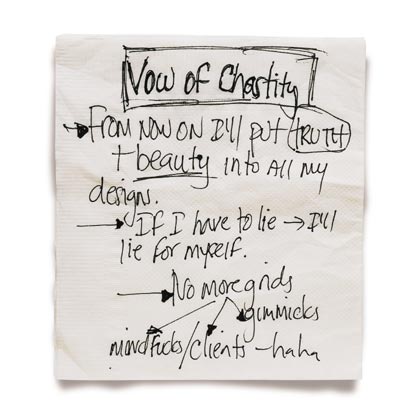
We cannot be ignorant to the truth that 99% of design exists within the propaganda model. Just sayin'. So fighting against this wave takes courage, passion and dedication. Most of all it takes empathy, and that requires love.
Creativity
Creativity.
What. Is. It ?
What I've read so far on 'Creativity' is a bit like what I've read on 'Design Thinking' academics trying to define a buzz word and concrete 'the sign' (in this case the term) to an ambiguous (lets face it there's no 'common' elements that are convincing) set of .. values. The argument almost becomes a battle of linguistics. The chain of argument which is largely empirical or behaviorist is weak - and quite meaningless. Maybe the academics are hoping that if enough of them agree on what 'Creativity' means - then that'll become the common agreement ..the truth .. after all that's how semiosis works. (and research ((don't shoot me))
I also think there are philosophical issues which come to mind like 'Is Creativity a Universal? and if so, then, does it even exist?' This path leads nicely to the fact that if creativity cannot be explained then it may be easier to start with - what Creativity 'is not' (deductive reasoning)
Then others state the obvious. Process. From divergent (play, open) to convergent (decision, closed) thinking. (Although I see this more of a popping in and out of both, feedback looping type scenario)
Nothing I've read so far has come even close to striking a chord with me until I came across this video of John Cleese talking about creativity. (It also has a FAB ending)
So good. Sooooo much better than the million of LAME TED talks by 'top design professionals'
I follow Improvisation Blog Which is penned by fellow kiwi Mark Johnson. How I came across the site is a bit odd, I basically saw him blogging at Ascelitite 2012 and decided to look it up. The guy is a machine and he pretty much spouts intense and intriguing thoughts around all things Ed Tech and HE related.
Anyway, he had posted the video on his post on Creativity (which is a breath of fresh air). As a designer and artist I can relate to 'defining absences' (which agrees with me more than 'making new connections')(Tho Cleese explore this admirably).
This is why I simply adore 'the space in between' I am in love with it, it's what all artists seek, and it's what all viewers search for. There's an is-ness and at-ness about the experience, epiphenomenal qualia. To me, this is the creative space.
My whole life I've been called a 'creative' and 'unique' person.. to the point where I wasn't sure if it was a complement or not. And when your livelihood depends on being creative and clients expect you to come up with amazing creative solutions each time - well that can threaten what creativity is - a fun, playful and experimental endeavor! It feels strange to try to define something which is so personal. It's like defining 'love'.
I'll protect my creative ways and nurture them, avoid exhausting them. Go to cafe's - visit galerrys, walk in nature and continue to feel inspired.
Thoughts on Instructional Design
You know something's changed when you find this page funny.
Today I finally found some half decent websites (not including the one above) for 'designers' who work on instructional projects. The resources for this field are growing with designers frustrated at the gap they find themselves in between education (higher ed. to be specific) and design.
Usable learning is quite good as a start point after you've read this to get a rather genreal overview of how it's all connected. Emergent radio is a station you can stream to provoke thoughts (if not a little frustrating and annoying) and Upsideleanring is a nice place to refresh and get some inspiration.
It took me quite a while to understand that the field of Instructional Design is not a typical filed of 'design' per se. And after attending Ascilite in Wellington this year I kind of, well, felt annoyed that people who had not been trained as 'designers' in the traditional sense, were calling themselves designers and using the term 'design' willy nilly. (I have 15 pages of frustrated notes but shows the need for my position!)
At the end of the day both graphic designers and instructional designers use design thinking, with the latter focusing on specific learner models and the former focusing on design principals. There needs to be more obvious and open communication between these two areas instead of designers creating with a lack of pedagogy and instructional experts advising with a lack of design theory. I'd also like if both parties didn't claim to be experts about the other if in fact they are not.
I am defiantly no expert in pedagogy learning outcomes and instructional design but luckily I work in a collaborative team with people who are. I am however trying to increase my knowledge in this area because I cannot design without doing so. I have learnt so much in the past 5 months of working within the University - but there is a long way to go, and I'm privileged to be gaining knowledge with every job I'm involved with.
Oh and I shan't forget to mention Hybrid Pedagogy it's one of the best sites I've found thus far (they have a FB page too)
Art vs. Design ... (See I put a 'vs' in there largely implying some sort of disharmony)
I often get asked "Gala, what's the difference between art and design?" It's one of those questions where I'm suddenly in a minefield, a maze - I see all the connections, I take a second, I zoom in - I contextualise - find myself and then define a box, a frame, an answer.
The box is never the full picture, and I find it extremely frustrating having to define a system or process. The problem with generalisations is exactly that - I'd much rather have a discussion - and visualise from all possible angles and perspectives. It seems to me that nobody seems to have the 'time' anymore. It seems to me like the value of time is continually shifting - becoming shorter whilst our lives are speeding up (Im with Paul Virillio on this one in terms of what this is doing to our communities). Being a holistic thinker and having to explain things in a cartesian ontology means supporting a value system where some ideas hold value over others. Academia is strongly rooted in this linear and hierarchal system, strongly supported by the scientific notion of 'weighted evidence'. But what of life's cyclic nature?
So when I get asked the question I kind of feel like my brain has a wee seizure (haha!) and my initial reaction is to make some horrible noise to communicate it all like "blaaarghshfkhsfkhs" these are the things that have occurred to me lately, and I think it will be useful for me to write down.
Lately I have been very attracted by the work of Barbara Kruger because she bridges art and design, I'm attracted to open source, and the idea of tool making and even design anarchy - hell why not make the most of both po mo and mo!
...but largely I feel guilty when I design because:
I guess at the end of the day as long as I'm aware of these factors, and question the true worth of my work then I'm doing OK - luckily enough I'm in educational media - a field where communication is taken critically and at a user level!
So, next time someone asks "What's the difference between art and design?" I can say, "Well if you were wanting a black and white answer, I'd say design is more rooted and beholden to modernism whereas art is in a post modern era and thus largely less restricted by social norms"
I give myself a hug, it's ok to acknowledge that the question strikes a chord with me and my self conceptualisation as both an artist and a designer.
Its OK to wear two hats.
phew.
The box is never the full picture, and I find it extremely frustrating having to define a system or process. The problem with generalisations is exactly that - I'd much rather have a discussion - and visualise from all possible angles and perspectives. It seems to me that nobody seems to have the 'time' anymore. It seems to me like the value of time is continually shifting - becoming shorter whilst our lives are speeding up (Im with Paul Virillio on this one in terms of what this is doing to our communities). Being a holistic thinker and having to explain things in a cartesian ontology means supporting a value system where some ideas hold value over others. Academia is strongly rooted in this linear and hierarchal system, strongly supported by the scientific notion of 'weighted evidence'. But what of life's cyclic nature?
So when I get asked the question I kind of feel like my brain has a wee seizure (haha!) and my initial reaction is to make some horrible noise to communicate it all like "blaaarghshfkhsfkhs" these are the things that have occurred to me lately, and I think it will be useful for me to write down.
- I see design as highly influenced and framed within modernism.
- I see art as post-modern (either re-constructive or de-constructive).
- I see myself either falling into one or the other depending on circumstance.
- I struggle with both - because of the influence of the other (po-mo vs. mo)
- I am in love with where and when they meet, reference each other or reference themselves.
Lately I have been very attracted by the work of Barbara Kruger because she bridges art and design, I'm attracted to open source, and the idea of tool making and even design anarchy - hell why not make the most of both po mo and mo!
...but largely I feel guilty when I design because:
- It is hard avoiding the pitfalls of modernism when all the rules (hard truths) around design are based on it.
- It is hard working with myths as that's the framework design uses to aim at users.
- It is hard treating 'the sign' with 'value' when the post modern part of myself believes that we are now largely living in a world of 'empty signs' (due to the myths) (and I am reinforcing this)
- It is not my place here to be ironic, it is my place to deliver a message.
- Within design there is am emphasis on convergent thinking over divergent thinking, (hey one's before the other in the process right!) to me this impedes on creativity.
- Due to the above point 'process' is often devalued compared to 'end product'
- Design often uses 'art' to disguise itself and make myth luring (aesthetics over function)
I guess at the end of the day as long as I'm aware of these factors, and question the true worth of my work then I'm doing OK - luckily enough I'm in educational media - a field where communication is taken critically and at a user level!
So, next time someone asks "What's the difference between art and design?" I can say, "Well if you were wanting a black and white answer, I'd say design is more rooted and beholden to modernism whereas art is in a post modern era and thus largely less restricted by social norms"
I give myself a hug, it's ok to acknowledge that the question strikes a chord with me and my self conceptualisation as both an artist and a designer.
Its OK to wear two hats.
phew.
![]() |
| Barbara Kruger |
Vitruvius
Vitruvius C1BC:
1. Firmitas: The strength and durability of the design
2. Utilitas: A designs usefulness and suitability for the needs of its intended users
3. Venustas: The beauty of the design
Problems that matter
I've been thinking, reading, sketching and ideating. Implementing social change through non-hierarchal webs, creating tools, fostering the community. Realising my part in it all - as a node, able to see the wider picture, realising context, staying critical but maintaining a belief in creativity - in change and in improved systems. Focusing on play, experiential learning, simplicity whilst maintianing respect for the past - what it has taught us, semiotics, social construct and cultural differences. Sustainability, connectivism, synergies and scaffolds.
Putting these thoughts into practice, into process. My moral responsibility as a designer, and how it's ok to make mistakes learn from the past and look constantly towards the future.
Quote
In his great book The Laws of Simplicity, designer and educator John Maeda writes, “The simplest way to achieve simplicity is through thoughtful reduction.” With a million different bits and bytes coming at us every day, simplicity isn’t just a design imperative any longer, it’s a productivity imperative - if not a sanity imperative.
Subscribe to:
Posts (Atom)